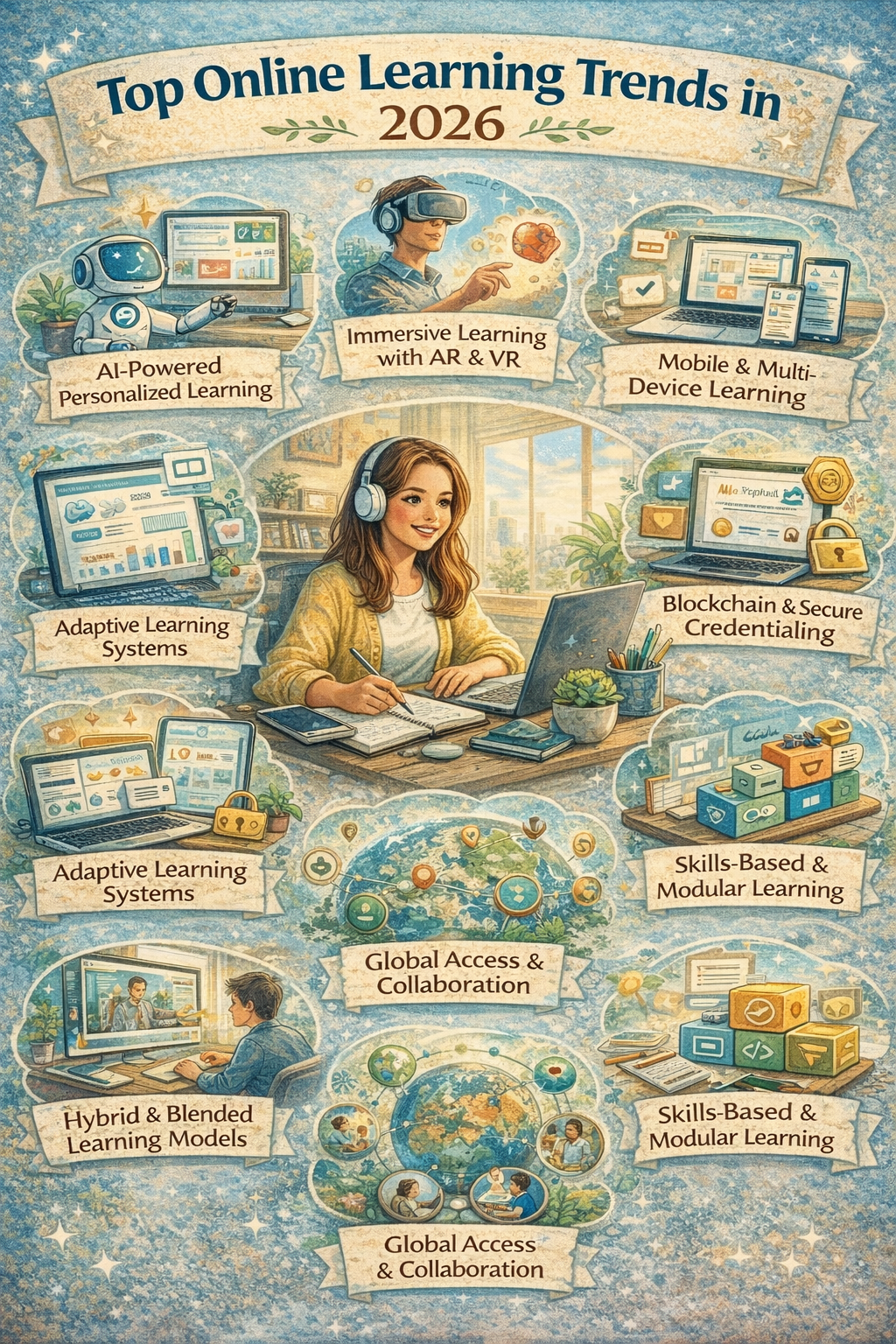
Top Online Learning Trends in 2026
Online learning has grown rapidly over the past decade, evolving from simple video lectures to highly sophisticated, technology-driven educational experiences. In 2026, digital learning is not just an alternative to traditional education — it has become a dynamic ecosystem shaped by technological innovation, personalized experiences, and global access. Trends like artificial intelligence, immersive technologies, microlearning, and secure credentialing are redefining how learners interact with content, instructors, and each other.
Here’s a detailed look at the top online learning trends of 2026, explained in a clear and user-friendly way.
1. AI-Powered Personalized Learning
Artificial intelligence (AI) is one of the most transformative forces in online education. In 2026, AI is being used extensively to tailor learning experiences to individual students. Instead of a “one-size-fits-all” model, modern platforms adapt courses based on a learner’s pace, performance, and unique needs. This means that when a student struggles with a concept, the system can automatically adjust the difficulty, provide additional practice, or suggest alternate explanations to help understanding.
AI also powers real-time feedback, automated assessments, and smart content recommendations, significantly improving learner engagement and course completion rates. This personalization helps learners stay motivated and supports deeper learning outcomes.
2. Adaptive Learning Systems
Closely related to AI, adaptive learning technologies tailor educational paths to each learner. Unlike static online courses, adaptive systems use algorithms to track performance and present content that matches the learner’s strengths and weaknesses. For example, if a student masters a topic quickly, the system can accelerate to more advanced material. If they struggle, the system can offer remedial lessons or alternate examples.
This approach is especially valuable in skill-based learning and professional education, where learners may have varied starting competencies. Adaptive learning ensures that each student remains challenged but not overwhelmed, creating an efficient learning journey.
3. Microlearning and Bite-Sized Content
Attention spans and busy schedules often make long online courses difficult to complete. Microlearning addresses this by breaking educational content into short, focused lessons that can be consumed in minutes. These bite-sized modules are ideal for learners juggling jobs, family, and other responsibilities.
Microlearning improves engagement and knowledge retention by focusing on specific concepts at a time. It’s also mobile-friendly, meaning learners can study on the go, whether during a commute or a lunch break. This trend is particularly popular with adult learners and professionals seeking to upskill quickly.
4. Immersive Learning with AR and VR
Immersive technologies such as Augmented Reality (AR) and Virtual Reality (VR) are reshaping online education by providing hands-on, experiential learning. Instead of reading about a complex subject, students can “experience” it. For example, learners studying anatomy can explore a 3D human body, while history students can walk through ancient civilizations in a virtual environment.
These immersive experiences make abstract concepts concrete and memorable, which enhances understanding and retention. As AR and VR tools become more affordable and widely available, they are expected to play a major role in both formal education and corporate training programs.
5. Gamification and Engagement Tools
Gamification incorporates game-like features — such as points, badges, leaderboards, and challenges — into educational content. The goal is to boost motivation and engagement by making learning more interactive and enjoyable. Gamified elements encourage healthy competition and reward progress, which helps learners stay committed to their goals.
In 2026, gamification continues to be a powerful trend in both academic and professional training platforms, as it supports learner persistence and increases course completion rates.
6. Hybrid and Blended Learning Models
While fully online learning has become standard, hybrid and blended models are gaining traction. These approaches combine online coursework with face-to-face sessions or structured in-person activities. This hybrid trend acknowledges that while digital learning offers flexibility, some learners benefit from real-world interaction and collaborative environments.
Institutions are increasingly adopting blended learning frameworks to provide the best of both worlds — flexible online content and structured support where needed. Hybrid models also allow learners to customize their educational pathways based on personal preferences and access needs.
7. Skills-Based and Modular Learning
By 2026, online education is placing a stronger emphasis on skills rather than just course completion. Traditional degree programs are no longer the only pathway to career opportunities. Learners are increasingly pursuing modular courses, micro-credentials, and skill-based certifications that demonstrate specific competencies employers value.
These modular learning units can often be stacked together, allowing learners to build credentials over time and create personalized career pathways. This trend reflects the growing importance of practical, job-ready skills in a fast-changing workforce.
8. Blockchain and Secure Credentialing
With the expansion of online learning, verifying academic credentials has become crucial. Blockchain technology offers a secure and tamper-proof way to store and verify digital certificates, degrees, and badges. Because blockchain records are decentralized and permanent, learners can share credentials easily with employers and institutions.
This trend enhances trust in online qualifications and reduces fraud, ensuring that online learning achievements carry real value in the global job market.
9. Mobile and Multi-Device Learning
Online learning in 2026 is expected to be fully mobile-friendly. More learners access courses on their phones, tablets, or laptops, which requires platforms to be responsive and seamless across devices. Multi-device accessibility allows learners to switch between devices without losing progress, making learning more flexible and convenient.
This trend is particularly important in regions where desktops are less common, expanding access to education globally and enabling learners from diverse backgrounds to participate fully.
10. Global Access and Collaboration
Online learning inherently breaks down geographical barriers, enabling learners from all over the world to access high-quality education. In 2026, global collaboration in online education continues to grow, with diverse student populations, cross-border projects, and culturally relevant content. This global trend fosters rich learning experiences and perspectives, connecting learners and educators across continents.
Cross-cultural collaboration prepares students for a connected world, encouraging communication and understanding among global learners.
Conclusion: The Future of Online Learning
Online learning in 2026 is not just about accessing courses; it is about engaging, personalized, and meaningful educational experiences. The trends shaping this future — from AI personalization and immersive technologies to microlearning and secure digital credentials — reflect a shift toward learner-centric and skills-oriented education.
As technology evolves, online learning continues to adapt to diverse needs, enabling learners of all ages, backgrounds, and goals to thrive. Whether you are a student, a professional seeking upskilling, or an educator designing courses, these trends highlight how education is becoming more flexible, inclusive, and
powerful than ever before.
afrikato afrikato afrikato afrikato afrikato afrikato afrikato afrikato afrikato afrikato afrikato afrikato afrikato afrikato afrikato afrikato afrikato afrikato afrikato afrikato afrikato afrikato afrikato afrikato afrikato afrikato afrikato afrikato afrikato afrikato afrikato afrikato afrikato afrikato afrikato afrikato afrikato afrikato afrikato afrikato afrikato afrikato afrikato afrikato afrikato afrikato afrikato afrikato afrikato afrikato afrikato afrikato afrikato afrikato afrikato afrikato afrikato afrikato afrikato afrikato afrikato afrikato afrikato afrikato afrikato afrikato afrikato afrikato afrikato afrikato afrikato afrikato afrikato afrikato afrikato afrikato afrikato afrikato afrikato afrikato afrikato afrikato afrikato afrikato afrikato afrikato afrikato afrikato afrikato afrikato afrikato afrikato afrikato afrikato afrikato afrikato afrikato afrikato afrikato afrikato afrikato afrikato afrikato afrikato afrikato afrikato afrikato afrikato afrikato afrikato afrikato afrikato afrikato afrikato afrikato afrikato afrikato afrikato afrikato afrikato afrikato afrikato afrikato afrikato afrikato afrikato afrikato afrikato afrikato afrikato afrikato afrikato afrikato afrikato afrikato afrikato afrikato afrikato afrikato afrikato afrikato afrikato afrikato afrikato afrikato afrikato afrikato afrikato afrikato afrikato afrikato afrikato afrikato afrikato afrikato afrikato afrikato afrikato afrikato afrikato afrikato afrikato afrikato afrikato afrikato afrikato afrikato
Comments
Post a Comment